OnePlus Open in 2026: Is This Foldable Still Worth Buying?

The OnePlus Open was one of the most convincing book-style foldables when it launched, and many of its best ideas still hold up in 2026. It has a phone-like 6.31-inch cover screen, a 7.82-inch inner display, Open Canvas multitasking, 16GB of RAM, 512GB of fast storage, 67W charging and a flexible triple-camera system. The problem is age: newer foldables now exist, and the Open’s remaining software-support window is shorter than it was at launch.

Bottom line: The OnePlus Open can still be a great 2026 buy at a substantial discount, especially if you care about multitasking, a comfortable cover screen and fast charging. Do not pay close to its original $1,699.99 price unless you have a very specific reason. The biggest risks are buying an aging foldable, no wireless charging, weaker water protection than some newer rivals and a support window that is already partly used.
Key pointDetails
Original/current listed US price$1,699.99 on the OnePlus US product page
Cover display6.31-inch 2K LTPO AMOLED, 10-120Hz
Inner display7.82-inch 2K LTPO AMOLED, 1-120Hz
ProcessorSnapdragon 8 Gen 2
Memory / storage16GB LPDDR5X + 512GB UFS 4.0
Battery / charging4,805mAh and 67W SUPERVOOC wired charging
Rear cameras48MP main with OIS + 64MP 3x telephoto + 48MP ultra-wide
Software promiseAt least four Android OS generations and five years of security updates from launch

The OnePlus Open still gets the foldable shape right

The cover screen is one of the reasons the Open has aged better than many first-generation foldables. At 6.31 inches with a conventional 20:9-style shape, it behaves like a normal phone when the device is closed. You do not have to unfold it every time you want to answer a message, check a map or scroll through an app.

Open it and the 7.82-inch inner screen gives you the space that makes a book-style foldable worth carrying. Both displays support adaptive high refresh rates, and the phone weighs about 239g in the Voyager Black version, which remains reasonable for a device with two large screens.

OnePlus lists the dimensions, display specifications, processor, memory and charging details on its official OnePlus Open specifications page.

Open Canvas remains the software feature competitors have to beat

Foldable hardware only matters if the software gives you a reason to unfold it. OnePlus Open Canvas is built around multi-window work, letting you arrange multiple apps across the larger display and move between them more naturally than a simple two-app split screen.

That makes the Open especially useful for combinations such as email plus a document, maps plus messages, a video plus notes, or research across several apps. If you mostly use one app at a time, a foldable may be unnecessary. If you frequently multitask, the extra screen area changes how useful a phone can be for work.

Snapdragon 8 Gen 2 is old, but not slow

The Snapdragon 8 Gen 2 was flagship silicon when the OnePlus Open launched. It is no longer the newest chip in 2026, but paired with 16GB of LPDDR5X RAM and 512GB of UFS 4.0 storage, it still has more than enough performance for normal multitasking, media, productivity and most games.

The reason to prefer a newer foldable is not that the Open suddenly cannot run Android apps. Newer chips can offer better efficiency, newer AI capabilities and longer future support. The Open remains fast enough; the question is how long you plan to keep it.

The camera system is still more serious than many older foldables

OnePlus equipped the Open with a 48MP OIS main camera, a 64MP telephoto camera with 3x optical zoom and a 48MP ultra-wide camera. That is a genuinely useful three-camera layout and one reason the Open was competitive with traditional flagship phones at launch.

Independent testing at launch was generally positive about the camera system while still identifying low-light and processing weaknesses compared with the very best camera phones. In 2026, the Open should be judged as a discounted older flagship camera system, not as the current photography benchmark.

For an independent hands-on reference, Tom’s Guide’s OnePlus Open review praises the storage and overall foldable design while noting low-light camera weakness and the absence of wireless charging.

67W charging is still excellent; no wireless charging is still annoying

The 4,805mAh battery supports 67W SUPERVOOC wired charging. Fast wired charging remains one of the Open’s practical strengths because it reduces the penalty of a large dual-screen device when you need a quick top-up.

The Open does not include wireless charging. That mattered at launch and matters more in 2026 because buyers spending flagship money increasingly expect both fast wired and convenient wireless options. If your desk, car and bedside setup already revolve around wireless chargers, this is not a small omission.

The software-support clock is already running

OnePlus promised the Open at least four generations of Android OS upgrades and five years of security updates from launch. That was a respectable commitment when the device arrived with Android 13, but buying in 2026 means part of that support period has already passed.

This is one of the biggest differences between buying a new flagship and buying an older flagship at a discount. The hardware may remain fast, but the remaining guaranteed support window is shorter. If you expect to keep your next phone for four or five more years, check the current update roadmap before purchasing.

OnePlus states the four-generation Android and five-year security commitment in the footnotes of its official Open specifications.

Be more cautious when buying a used foldable

Used pricing can make the OnePlus Open tempting, but a folding phone has more mechanical and display variables than a conventional slab phone. Inspect the inner display for dead pixels, lines, bubbles or lifting around the crease. Check the hinge for uneven movement, confirm both screens register touch correctly, and test the cameras, USB-C port, speakers and fingerprint sensor.

Battery health also matters because the phone is now several years old. A bargain that needs an inner display repair or battery service can become expensive quickly. If possible, prioritize a seller with a return window or warranty and verify the device’s repair history before paying.

Who should buy the OnePlus Open in 2026?

  • Buy it if you can get a new or well-protected unit at a large discount from the original price.
  • Buy it if Open Canvas multitasking and the phone-like cover screen are more important than having the newest chipset.
  • Buy it if fast wired charging and 512GB of storage matter to you.
  • Skip it if you expect many more years of guaranteed software support.
  • Skip it if wireless charging is part of your everyday setup.
  • Skip it if you are uncomfortable with the repair risk and durability trade-offs of an older foldable.

Is the OnePlus Open still worth buying?

Yes, at the right price. The OnePlus Open still offers a genuinely useful foldable design, a good cover-screen shape, excellent multitasking, strong camera versatility and fast charging. Its core experience has not become irrelevant simply because the processor is no longer current.

But 2026 buyers should be much more price-sensitive than launch-day buyers. You are accepting an older chipset, no wireless charging and a support window that is already partly consumed. If the discount is large enough, those compromises can be reasonable. If the price is close to a current-generation foldable, buy the newer phone instead.

Frequently asked questions

Does the OnePlus Open have wireless charging?

No. The OnePlus Open supports 67W wired SUPERVOOC charging but does not support wireless charging.

How much RAM and storage does the OnePlus Open have?

The standard specification includes 16GB of LPDDR5X RAM and 512GB of UFS 4.0 storage.

What processor is in the OnePlus Open?

It uses Qualcomm’s Snapdragon 8 Gen 2 platform.

How long is the OnePlus Open supported?

OnePlus promised at least four generations of Android OS upgrades and five years of security updates from the device’s launch.

Should I buy a used OnePlus Open?

Only if the price reflects the age and you can thoroughly inspect the hinge, inner display, battery, charging port and repair history. A return policy or warranty is especially valuable on a used foldable.
Samsung Ring: What to Know Before Buying the Galaxy Ring

If you search for a Samsung Ring, the product you are looking for is the Samsung Galaxy Ring. It is a screen-free health and sleep tracker designed to sit on your finger instead of your wrist. It tracks metrics through Samsung Health, uses a portable charging case, and does not require a subscription to view your health data. Samsung currently lists the Galaxy Ring at $399.99 in the US before trade-in offers.

Bottom line: The Galaxy Ring is best for Android users – especially Galaxy phone owners – who want passive sleep and wellness tracking without wearing a smartwatch to bed or paying a monthly membership. It is not a smartwatch replacement, it does not work with iPhone, and its health insights are for wellness rather than medical diagnosis.
Key pointDetails
US price at research time$399.99 before trade-in offers
SizesUS sizes 5 through 15 are listed by Samsung in current buying options
WeightApproximately 2.3g to 3.3g depending on size
SensorsOptical heart-rate sensor, temperature sensor and accelerometer
Durability10ATM and IP68
BatteryUp to 6 days on smaller/mid sizes and up to 7 days on larger sizes, depending on use
CompatibilityAndroid 11 or later; Samsung Health and Samsung account required
SubscriptionNo subscription fee to view Galaxy Ring data in Samsung Health

The biggest advantage is what you do not have to wear

A smartwatch is excellent for notifications, workouts, maps and apps, but some people do not want a screen on their wrist all day and night. The Galaxy Ring is built around the opposite idea: wear a small sensor, forget about it, and check the results later in Samsung Health.

That makes the ring especially appealing for sleep tracking. A lightweight ring can be less intrusive in bed than a watch, and the lack of a screen removes the temptation to check notifications at night. The trade-off is obvious: there is no display, no app launcher and no on-device workout interface.

No subscription is a major long-term value advantage

Samsung states that Galaxy Ring health data is available through Samsung Health without a subscription fee. That matters because the smart-ring category often combines a hardware purchase with an ongoing membership for deeper insights.

A no-subscription model makes the Galaxy Ring’s $399.99 purchase price easier to evaluate over multiple years. You still need a compatible Android phone and a Samsung account, but there is no separate monthly fee simply to view the data the ring collects.

Samsung explicitly confirms the no-subscription model in its Galaxy Ring purchase FAQ.

Sizing is not optional – use the sizing kit

Smart-ring sizing deserves more attention than normal jewelry sizing because sensor contact affects tracking quality and comfort. Samsung recommends using its sizing kit before confirming an order. The ring should be secure enough to keep the sensors against your skin without feeling tight or uncomfortable.

Do not assume your usual ring size is automatically correct. Finger size can also change through the day, with temperature, exercise and sleep. If possible, wear the sample size for a full day and overnight before choosing the real ring.

Samsung’s US Galaxy Ring buying page includes the sizing-kit process and current size options.

What the Galaxy Ring actually tracks

The Galaxy Ring uses an optical heart-rate sensor, skin-temperature sensor and accelerometer. Samsung Health uses this data for sleep analysis, heart-rate trends, activity tracking and wellness features such as Energy Score. The exact set of features can vary by phone, region and software version.

This is best understood as trend tracking. The ring can help you notice patterns in sleep, activity and recovery, but Samsung states that its health features are intended for general wellness and fitness, not for diagnosing, treating or monitoring a medical condition. If a metric causes concern, treat it as a reason to seek appropriate professional advice rather than as a diagnosis.

Battery life depends on ring size

Samsung rates Galaxy Ring battery life at up to six days for many smaller and mid-size rings and up to seven days for larger sizes. The charging case adds convenience because you can top up the ring without leaving it connected to a cable on a desk.

Actual endurance depends on ring size, feature use, reconnections and tracking patterns. The practical benefit is that you are not dealing with the daily charging routine common to many smartwatches. That is particularly useful if sleep tracking is the main reason you want a wearable.

Android compatibility is broad, but Galaxy phones get the best experience

Samsung says the Galaxy Ring requires Android 11 or later, at least 1.5GB of memory, the Galaxy Wearable app, Samsung Health and a Samsung account. It does not support iPhone as a complete companion platform.

Some Galaxy-specific interactions also require a compatible Samsung phone. For example, Samsung documents a double-pinch gesture for certain camera and alarm controls on supported Galaxy devices. If you use a non-Samsung Android phone, verify the specific features you care about before buying rather than assuming full feature parity.

Galaxy Ring vs Galaxy Watch: which one is better?

Choose the Galaxy Ring if your priority is passive tracking, sleep comfort and less screen time. Choose a Galaxy Watch if you want workout controls, notifications, a display, apps, navigation and more direct interaction during the day.

Some users will get the best experience from both: the ring at night and a watch when they want a screen. But buying both is not necessary for everyone. If you only care about sleep and wellness trends, the ring is easier to justify. If you want a full smartwatch, the Ring alone will feel limited.

The limitations to understand before buying

  • No iPhone support as a full Galaxy Ring platform.
  • No display, notifications or third-party apps on the ring itself.
  • No built-in GPS listed in the Galaxy Ring hardware specifications, so it is not a standalone GPS workout tracker.
  • Health metrics are intended for general wellness, not medical diagnosis.
  • Sizing matters more than with a watch, so the sizing kit should be treated as part of the purchase process.
  • Battery life varies by ring size and usage pattern.

Who should buy the Samsung Galaxy Ring?

  • Galaxy phone owners who want sleep and recovery data without wearing a watch overnight.
  • Android users who want a smart ring with no monthly subscription for Samsung Health data.
  • People who prefer a discreet wearable with multi-day battery life.
  • Skip it if you use an iPhone.
  • Skip it if you mainly want detailed workout screens, maps or smartwatch notifications.
  • Skip it if you need medical-grade monitoring or expect the ring to replace professional medical evaluation.

Is the Samsung Ring worth it?

The Galaxy Ring is worth it when its form factor solves a specific problem: you want consistent wellness and sleep tracking but do not want a smartwatch on your wrist around the clock. Samsung’s no-subscription model and charging case make the long-term ownership experience easier to understand.

The value is weaker if you already wear and enjoy a Galaxy Watch 24/7, or if you use an iPhone. For the right Android user, however, the Galaxy Ring is not trying to be a tiny smartwatch. It is a low-friction sensor you can wear continuously, and that simplicity is the reason to buy it.

Frequently asked questions

Does the Samsung Galaxy Ring require a subscription?

No. Samsung says Galaxy Ring data can be viewed in Samsung Health without a subscription fee.

Does the Galaxy Ring work with iPhone?

No. Samsung’s listed compatibility requires Android 11 or later along with Samsung Health, Galaxy Wearable and a Samsung account.

How long does the Galaxy Ring battery last?

Samsung rates typical battery life at up to six or seven days depending on ring size and usage.

Can I swim with the Galaxy Ring?

Samsung lists 10ATM and IP68 durability, but follow Samsung’s water-resistance guidance and avoid treating any wearable as indestructible. Water resistance can decline with wear and is not the same as a guarantee against all water damage.

Is Galaxy Ring health data medical advice?

No. Samsung states that the health and wellness tracking features are not intended to diagnose, treat, monitor or manage a medical condition.

Samsung Galaxy S25 in 2026: Is It Still Worth Buying?

The Samsung Galaxy S25 is no longer Samsung’s newest compact flagship, but that does not automatically make it a bad buy. It still has a 120Hz Dynamic AMOLED 2X display, Snapdragon 8 Elite for Galaxy, 12GB of RAM, a useful 3x telephoto camera and a long update commitment. The real question in 2026 is price: the newer Galaxy S26 now exists, so the S25 only becomes compelling when the discount is meaningful.

Bottom line: The Galaxy S25 is still an excellent compact Android phone if you can buy it well below the price of a comparable Galaxy S26. At similar prices, buy the S26. The S25’s strengths are performance, size, cameras and long support; its biggest long-term weakness is the smaller 4,000mAh battery.
Key pointDetails
Display6.2-inch FHD+ Dynamic AMOLED 2X, up to 120Hz
ProcessorSnapdragon 8 Elite for Galaxy
Memory12GB RAM
Rear cameras50MP main + 12MP ultra-wide + 10MP telephoto with 3x optical zoom
Battery4,000mAh
Weight162g
Software supportSeven years of OS and security updates from launch
Current contextGalaxy S26 launched in March 2026 with a larger 4,300mAh battery and newer platform

Why the Galaxy S25 still makes sense in 2026

The S25’s age is not a performance problem. Snapdragon 8 Elite for Galaxy and 12GB of RAM are still far beyond what most everyday apps require. Messaging, photos, navigation, multitasking, social media, productivity and even demanding games are not reasons to avoid the phone in 2026.

The bigger reason to consider the S25 is size. At 162g with a 6.2-inch display, it is easier to use one-handed and carry than many large flagship phones. Compact high-end Android options remain relatively limited, so the S25 continues to fill a real niche even after a newer generation arrives.

Samsung lists the S25’s display, cameras, 12GB memory and 4,000mAh battery on the official Galaxy S25 specifications page.

The camera system is still versatile, even if it is not the newest hardware

The Galaxy S25 combines a 50MP main camera, a 12MP ultra-wide and a 10MP telephoto camera with 3x optical zoom. That gives you three genuinely useful focal lengths rather than adding low-value sensors for the sake of a camera count.

For travel, family photos and everyday shooting, the telephoto lens remains one of the reasons to choose the S25 over many cheaper phones. The camera hardware is not a reason to upgrade from a recent S-series phone by itself, but it is still a complete package for someone moving up from a mid-range device.

Battery is the most important compromise to understand

The S25 uses a 4,000mAh battery. Samsung rates it for up to 29 hours of video playback under its test conditions, but capacity matters when comparing generations. The newer Galaxy S26 increases the battery to 4,300mAh and is rated for up to 30 hours of video playback.

That does not mean the S25 has poor battery life, but it is the specification most likely to influence a buyer who expects heavy daily use or wants to keep the phone for many years. Batteries also lose capacity as they age, so buying an older used S25 is a different decision from buying new old stock with a fresh battery.

Seven years of updates makes the S25 safer to buy late

Samsung committed the Galaxy S25 series to seven years of operating system and security updates. That long support window is important in 2026 because you are not buying a phone that is already close to the end of its software life.

For most users, the chipset will remain capable long before software support becomes the limiting factor. This is one of the strongest arguments for buying the S25 at a discount instead of a cheaper phone with a shorter update policy.

Galaxy S25 vs Galaxy S26: the price gap decides the winner

Samsung introduced the Galaxy S26 in March 2026. The newer model has a 6.3-inch display, a 4,300mAh battery and a newer processing platform. Samsung lists the S26 starting at $899.99 for 256GB before promotions, while the S25 remains listed in 128GB and 256GB configurations.

Because Samsung frequently runs discounts and trade-in offers, list price is less useful than the amount you will actually pay today. If an S25 is only slightly cheaper than an S26 with the same storage, choose the S26. If the S25 is discounted by a few hundred dollars, it becomes much easier to recommend because the core experience is still flagship-level.

For the current generation comparison, see Samsung’s Galaxy S26 product page, which shows the newer model’s 6.3-inch display and 4,300mAh battery.

Do Galaxy AI features make the S25 feel old?

No, not in the way a traditional hardware feature would. The S25 launched as an AI-focused phone and continues to support Samsung’s Galaxy AI ecosystem, including features integrated into One UI. Some newer models may gain additional functions or run certain tasks more efficiently, but the S25 is not a pre-AI Galaxy phone trying to catch up.

AI should not be the main reason to buy the S25 in 2026. The better reasons are the compact form factor, camera flexibility, strong performance and long support policy.

Who should still buy a Galaxy S25?

  • Buy it if you want a compact premium Android phone and find it at a meaningful discount.
  • Buy it if you want a real telephoto camera without moving to a much larger phone.
  • Buy it if long software support is important and you plan to keep the phone for years.
  • Skip it if the S26 costs only a little more in the same storage configuration.
  • Skip it if battery endurance is your top priority and you are comfortable carrying a larger phone.
  • Be cautious with used units unless you can verify battery health, screen condition and remaining warranty.

Is the Samsung Galaxy S25 still worth buying in 2026?

Yes, but only at the right price. The S25 has not suddenly become slow or obsolete because the S26 launched. Its Snapdragon 8 Elite platform, 120Hz AMOLED display, triple-camera system and seven-year support policy still make it a premium phone.

The problem is value, not capability. Compare the final checkout price of the S25 and S26 with the same storage and without assuming that an older model is automatically cheaper. When the S25 is heavily discounted, it is one of the easiest ways to get a compact Samsung flagship experience for less. When the prices overlap, the newer S26 is the more sensible purchase.

Frequently asked questions

How long will the Galaxy S25 receive updates?

Samsung committed the Galaxy S25 series to seven years of operating system and security updates from launch.

Does the Galaxy S25 have a telephoto camera?

Yes. It has a 10MP telephoto camera with 3x optical zoom, alongside a 50MP main camera and 12MP ultra-wide camera.

Is the Galaxy S25 battery smaller than the S26 battery?

Yes. Samsung lists the S25 at 4,000mAh and the newer S26 at 4,300mAh.

Should I buy the Galaxy S25 or S26?

For most buyers, the answer depends on the live price. Choose the S26 when the cost is close. Choose the S25 when a strong discount makes the older model substantially cheaper.

Samsung Galaxy Tab S10 FE: Is It the Right Android Tablet for You?

The Samsung Galaxy Tab S10 FE is built for people who want more than a basic media tablet but do not need Samsung’s most expensive AMOLED hardware. It combines a 10.9-inch 90Hz display, an included S Pen, IP68 durability, expandable storage and Samsung DeX on the tablet itself. Samsung currently lists the 128GB Wi-Fi model at $549.99 in the US.

Bottom line: The Tab S10 FE is a strong fit for students, note-takers, families and light productivity users who value the included S Pen and Samsung software. The biggest caveats are its LCD panel, mid-range performance and the fact that its DeX experience cannot be extended to an external monitor through HDMI or Wireless DeX.
Key pointDetails
US price at research time$549.99 for 128GB Wi-Fi
Display10.9-inch LCD/TFT, 2304 x 1440, up to 90Hz
ProcessorExynos 1580
Memory / storage8GB + 128GB or 12GB + 256GB; microSD expansion supported
Battery8,000mAh; Samsung rates up to 20 hours of video playback
ChargingUp to 45W wired
S PenIncluded
DurabilityIP68

The S Pen is the feature that changes the buying decision

Plenty of Android tablets can stream video and browse the web. The reason to look at the Galaxy Tab S10 FE is the included S Pen. It turns the tablet into a much better tool for handwritten notes, annotating PDFs, sketching, signing documents and working in Samsung Notes.

That matters because stylus cost is often hidden when comparing tablets. With the S Pen included, the Tab S10 FE can be ready for school or note-taking without adding another accessory to the purchase. If you know you will never use a stylus, the value proposition becomes less distinctive and a cheaper tablet may be enough.

Samsung lists S Pen support, IP68 protection, battery capacity and storage options on its official Galaxy Tab S10 FE product page.

The 10.9-inch screen is good, but it is not Samsung’s premium display

The Tab S10 FE uses a 10.9-inch LCD/TFT panel with a 2304 x 1440 resolution and up to 90Hz refresh rate. It is sharp enough for reading, streaming, schoolwork and split-screen use, and the faster refresh rate helps the interface and S Pen interactions feel smoother.

The trade-off is display technology. Samsung reserves Dynamic AMOLED panels and 120Hz refresh rates for more expensive Galaxy Tab models. If your main reason for buying a tablet is watching HDR movies on the best possible screen, the FE model is not the top Samsung option. If your priority is productivity, notes and a balanced price, the LCD is easier to accept.

Performance is aimed at productivity, not flagship gaming

Samsung uses the Exynos 1580 in the Galaxy Tab S10 FE. Combined with 8GB of RAM in the 128GB model, it is well suited to document editing, web research, video calls, streaming, Samsung Notes and common Android apps. The 256GB configuration increases memory to 12GB, which is more attractive if you keep many apps open or expect to use the tablet for several years.

This is not the tablet to buy specifically for maximum frame rates in demanding games or desktop-class creative workloads. The FE line is designed around a balance of performance and price, and that is how it should be evaluated.

Samsung DeX is useful here, with one important limitation

The Galaxy Tab S10 FE can run Samsung DeX directly on its own screen, giving you a desktop-style workspace with resizable windows, a taskbar and better keyboard-and-mouse multitasking. That is useful for writing, email, spreadsheets and research when paired with a keyboard.

However, Samsung explicitly says the Tab S10 FE and S10 FE+ do not support HDMI output or Wireless DeX to a TV or monitor. That is a critical difference from some higher-end Galaxy Tab models. If your plan is to dock the tablet to a large monitor and use it like a lightweight laptop replacement, this limitation should be part of your decision.

Samsung explains the standalone DeX experience and the external-display limitation in its Tab S10 FE support guide.

Expandable storage is still a practical advantage

The Tab S10 FE is available with 128GB or 256GB of internal storage, and Samsung supports microSD expansion. That makes it easier to keep large video libraries, downloaded course material, photos and offline files without immediately paying for a higher-capacity tablet.

For most people, 128GB plus a microSD card is a sensible value configuration. If you install large games or work with big creative files, the 256GB model also gives you more RAM, which can make the upgrade more useful than storage capacity alone suggests.

Battery life is designed for full-day tablet use

Samsung gives the 10.9-inch Tab S10 FE an 8,000mAh battery and rates it for up to 20 hours of video playback under its test conditions. Real-world endurance depends on brightness, apps, connectivity and workload, but the capacity is large enough that battery life should not be the first concern for students or media users.

The tablet supports up to 45W charging. As with many Samsung devices, check what charger is included in your local package and make sure your adapter supports the required charging standard if you want the fastest wired speed.

IP68 is unusually useful on a productivity tablet

The Tab S10 FE carries an IP68 rating. That does not mean you should treat a tablet casually around water, but it provides more peace of mind than many competing mid-range tablets offer. For a device that may live in backpacks, classrooms, kitchens and travel bags, durability is a real quality-of-life feature.

Tab S10 FE or Tab S10 FE+: which size makes more sense?

The standard Tab S10 FE uses a 10.9-inch display and weighs about 497g in the Wi-Fi configuration, making it easier to hold and carry. The Tab S10 FE+ expands the screen to 13.1 inches and uses a larger 10,090mAh battery. Both target the same general productivity experience.

Choose the standard FE if portability matters and you expect to take handwritten notes while holding the tablet. Choose the FE+ if you mainly use the tablet on a desk, want more room for split-screen work or prefer a larger canvas for media and drawing.

Who should buy the Galaxy Tab S10 FE?

  • Students who want an included S Pen for notes, PDFs and coursework.
  • Samsung phone owners who want Quick Share, Samsung Notes, Galaxy ecosystem features and familiar software.
  • People who need expandable storage and IP68 durability in a mid-range tablet.
  • Skip it if an AMOLED screen is a top priority.
  • Skip it if you need HDMI or Wireless DeX to an external monitor.
  • Skip it if high-end gaming or professional creative performance is your main use case.

Is the Samsung Galaxy Tab S10 FE worth buying?

The Tab S10 FE is worth considering when its S Pen, Samsung software and durability solve real needs for you. It is not simply a cheaper flagship tablet; it makes deliberate compromises in display technology and external-display support to hit a lower price.

That makes the buying decision straightforward. If you want a portable Android tablet for notes, school, media and light productivity, the package is strong. If you want the best screen, fastest chipset or a monitor-docked DeX workstation, compare the higher Galaxy Tab S and current premium Android tablet options before spending the money.

Frequently asked questions

Does the Galaxy Tab S10 FE include an S Pen?

Yes. Samsung includes S Pen support with the Galaxy Tab S10 FE, which is one of the tablet’s main advantages for notes and annotation.

Does the Galaxy Tab S10 FE have an AMOLED display?

No. The 10.9-inch display is an LCD/TFT panel with a 2304 x 1440 resolution and up to 90Hz refresh rate.

Can the Galaxy Tab S10 FE use Samsung DeX?

Yes. It can run DeX directly on the tablet. Samsung says the FE model does not support HDMI output or Wireless DeX to an external display.

Does the Galaxy Tab S10 FE support a microSD card?

Yes. Samsung supports expandable microSD storage in addition to the tablet’s built-in 128GB or 256GB storage.

Is the Galaxy Tab S10 FE water resistant?

It carries an IP68 water- and dust-resistance rating, but normal care around water is still recommended.

Samsung Galaxy A17 5G: 10 Things to Know Before You Buy

The Samsung Galaxy A17 5G sits in the part of Samsung’s lineup where value matters more than headline specifications. It gives you a large AMOLED display, 5G, optical image stabilization on the main camera, a 5,000mAh battery, and unusually long software support for a budget phone. At the time of writing, Samsung lists the unlocked 128GB model in the US at $249.99.

Bottom line: The Galaxy A17 5G makes the most sense for buyers who want a dependable Samsung phone for everyday use and plan to keep it for several years. Its strongest advantages are the display, long update policy, OIS camera and simple Galaxy ecosystem. Its compromises are the 90Hz refresh rate, 25W wired charging, IP54 protection and more modest secondary cameras.
Key pointDetails
US price at research time$249.99 for 128GB unlocked on Samsung US
Display6.7-inch FHD+ Super AMOLED, up to 90Hz
Rear cameras50MP main with OIS + 5MP ultra-wide + 2MP macro
Battery5,000mAh
ChargingUp to 25W wired; no wireless charging or PowerShare
DurabilityIP54 splash/dust protection and Gorilla Glass Victus front protection
Software supportSix generations of OS upgrades and six years of security updates

1. The display is one of the Galaxy A17 5G’s best reasons to buy

A 6.7-inch Full HD+ Super AMOLED panel is a strong starting point at this price. AMOLED gives the phone the deep blacks and punchy contrast many buyers associate with Samsung’s more expensive devices, and the large screen is well suited to streaming, social media, maps and everyday browsing. The 90Hz refresh rate also makes scrolling feel smoother than a traditional 60Hz screen.

The compromise is that it stops at 90Hz rather than the 120Hz refresh rate common on pricier Galaxy phones. That difference is visible if you are moving down from a flagship, but it is unlikely to be a deal-breaker for someone upgrading from an older budget or mid-range phone.

Samsung highlights the 6.7-inch AMOLED display, IP54 protection, OIS camera and six-year support policy on its official Galaxy A17 5G page.

2. The main camera matters more than the camera count

The rear camera system combines a 50MP main camera, a 5MP ultra-wide and a 2MP macro camera. The feature that matters most is optical image stabilization on the main camera. OIS helps reduce blur from hand movement and is especially useful for low-light photos and steadier video.

Do not buy the A17 simply because it has three cameras. The 5MP ultra-wide and 2MP macro sensors are clearly secondary tools. The 50MP OIS-equipped main camera should be your default choice for the majority of photos. Samsung lists video recording at up to Full HD at 30fps on the A17, which is another reminder that this is a budget-focused device rather than a creator-oriented camera phone.

3. Battery life should be a bigger strength than charging speed

Samsung equips the Galaxy A17 5G with a 5,000mAh battery and supports up to 25W wired charging. That capacity is well matched to a 1080p-class display and a phone aimed at everyday use. For most buyers, the more important benefit is the large battery rather than how quickly it can refill.

The phone does not support wireless charging or Wireless PowerShare, and the wall charger is sold separately. If you already use a compatible USB-C PD/PPS charger, that may not matter. If this is your first USB-C phone, factor a charger into the real purchase cost.

Samsung confirms the 5,000mAh battery, 25W charging limit and lack of wireless charging in its Galaxy A17 charging support guide.

4. Six years of updates changes the value equation

The most important long-term feature may be the update policy. Samsung promises six generations of OS upgrades and six years of security updates for the Galaxy A17 5G. That is unusually strong support for a low-cost Android phone and makes the A17 more attractive for people who replace their phones only when they need to.

Long support does not guarantee that a budget processor will feel flagship-fast six years from now, but it does reduce the risk of the phone becoming unsupported while the hardware is still usable. For parents buying for a teenager, a secondary phone, or anyone trying to avoid a two-year replacement cycle, this is a meaningful advantage.

5. The AI features are useful, but keep expectations realistic

Samsung includes practical AI-assisted features such as Gemini integration and Circle to Search. Those are useful because they help with everyday tasks without requiring you to learn a completely new interface. You can identify something on screen, ask questions about what the camera sees, or use Google’s assistant tools from the same phone.

However, the A17 should not be treated as a cheaper version of an S-series Galaxy AI phone. Premium Samsung devices have more processing headroom and can receive additional device-specific AI features. Buy the A17 for its core phone experience first; treat its AI tools as a bonus.

6. IP54 protection is helpful, but this is not a waterproof phone

The Galaxy A17 5G carries an IP54 rating and Gorilla Glass Victus protection on the front. IP54 is useful against dust and splashes, but it is not the same as the IP67 or IP68 water-resistance ratings found on more expensive phones. You should not intentionally submerge the A17 or treat it as a phone designed for pool use.

This is still a welcome upgrade for a device at this price because accidental splashes and day-to-day wear are more realistic threats than extreme durability tests.

7. Performance should be judged by the job you need the phone to do

Samsung uses a 2.4GHz-class octa-core platform in the Galaxy A17 5G. The phone is designed for messaging, browsing, navigation, streaming, social apps and casual games. Those tasks fit the product well. Heavy 3D gaming, demanding video editing and years of high-end multitasking are not the use cases this phone is built around.

If your priority is maximum gaming performance, a higher-tier Galaxy A model or a discounted older flagship is worth comparing. If your priority is a reliable daily phone that does the basics well, spending more may not improve the parts of the experience you actually use.

8. Samsung’s ecosystem makes the A17 easier to live with

The A17 works with familiar Galaxy services such as Smart Switch, Quick Share, Samsung Wallet, Knox security and Samsung Health. That is especially useful if you already own Galaxy Buds, a Galaxy Watch, a Samsung tablet or a Windows PC you use with Quick Share.

This ecosystem advantage is difficult to see on a specification sheet, but it can matter more than a small benchmark difference. A phone that transfers your old data cleanly and works with the accessories you already own is often the better practical purchase.

9. Who should buy the Samsung Galaxy A17 5G?

  • Buy it if you want a Samsung phone under roughly $250 with a large AMOLED screen and long software support.
  • Buy it if you mostly use your phone for calls, messaging, social media, video, photos, navigation and everyday apps.
  • Buy it if you prefer keeping a phone for several years and value security updates more than benchmark scores.
  • Skip it if you need 120Hz, wireless charging, strong water resistance or flagship-level gaming.
  • Skip it if ultra-wide and zoom camera quality are major priorities; the camera system is built around the main 50MP sensor.

10. Is the Samsung Galaxy A17 5G worth buying?

Yes, for the right buyer. The Galaxy A17 5G is strongest when judged as a long-lasting everyday phone rather than a bargain flagship. The combination of a 6.7-inch AMOLED screen, OIS on the main camera, 5,000mAh battery, practical Samsung software and six years of support gives it a clear value story.

Before buying, compare the live price against Samsung’s A27 and A37 as well as discounted previous-generation phones. If the A17 remains meaningfully cheaper, it is an easy option to understand: you are paying for the fundamentals, not for premium extras you may never use.

Frequently asked questions

Does the Samsung Galaxy A17 5G support wireless charging?

No. Samsung states that the Galaxy A17 5G does not support wireless charging or Wireless PowerShare. It supports wired charging up to 25W.

Does the Galaxy A17 5G come with a charger?

The phone includes a USB-C cable, but Samsung sells the wall power adapter separately.

Is the Galaxy A17 5G waterproof?

No phone should be described as waterproof. The A17 has an IP54 rating for dust and splash resistance, which is lower than IP67 or IP68 protection.

How long will Samsung update the Galaxy A17 5G?

Samsung advertises six generations of OS upgrades and six years of security updates for the Galaxy A17 5G.

Does the Galaxy A17 5G have optical image stabilization?

Yes. The 50MP main rear camera includes OIS, which can help reduce blur and improve stability compared with a main camera without optical stabilization.

Google Pixel 10 Review: Is It Worth Buying in 2026?

The Google Pixel 10 is the base model in Google’s 2026 flagship lineup. Priced at $699, it sits $300 below the Pixel 10 Pro but shares many of the same features, including the Tensor G5 chip, the same AI capabilities, and 7 years of software updates. The big question is: do you actually need the Pro?

After using the Pixel 10 as a daily driver, here is everything you need to know.

Pixel 10 Specifications

SpecificationPixel 10
Display6.3-inch OLED, 1080 x 2400, 120Hz
ProcessorGoogle Tensor G5
RAM12 GB
Storage128 GB / 256 GB
Rear Camera50 MP main (wide) + 48 MP ultrawide
Front Camera10.5 MP
Battery4,575 mAh
Charging27W wired, 15W wireless
OSAndroid 16
Software Updates7 years
Water ResistanceIP68
Price$699 (128 GB) / $759 (256 GB)

Design and Build

The Pixel 10 shares the same design language as the Pixel 10 Pro with the signature camera bar, but uses a polycarbonate back instead of glass. This actually makes it more durable and lighter than the Pro. The aluminum frame is the same quality. Colors available: Obsidian, Porcelain, Peony, and Jade.

At 6.3 inches, the Pixel 10 is noticeably more compact than the 6.7-inch Pro. For one-handed use, the smaller size is a real advantage. The phone weighs 185 grams, which is comfortable for extended use.

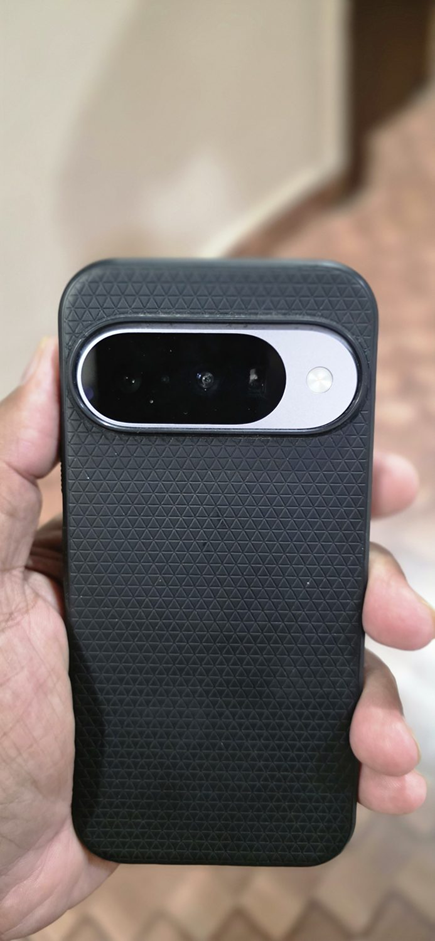
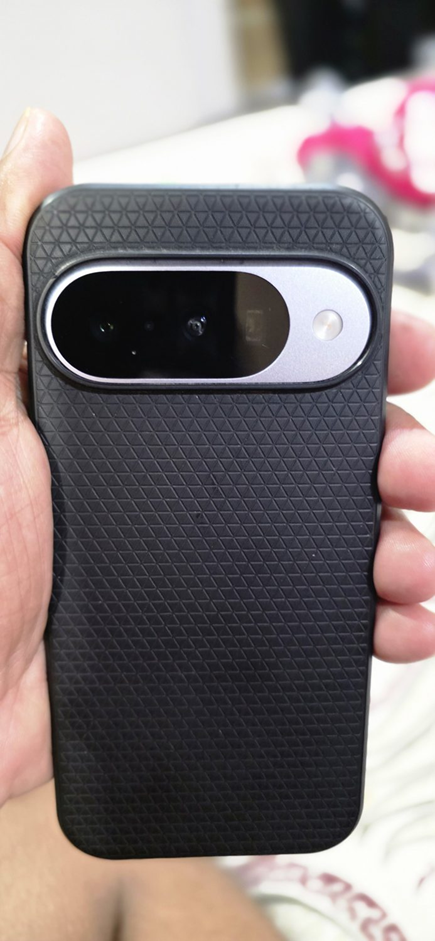
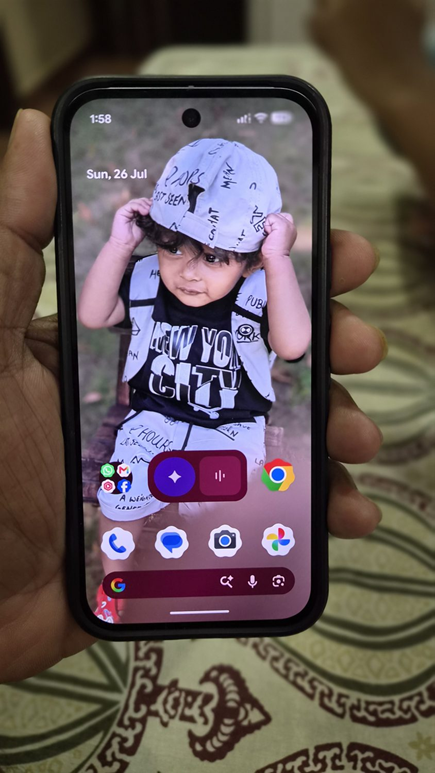
The Pixel 10 held in one hand. At 6.3 inches it is genuinely usable one-handed.

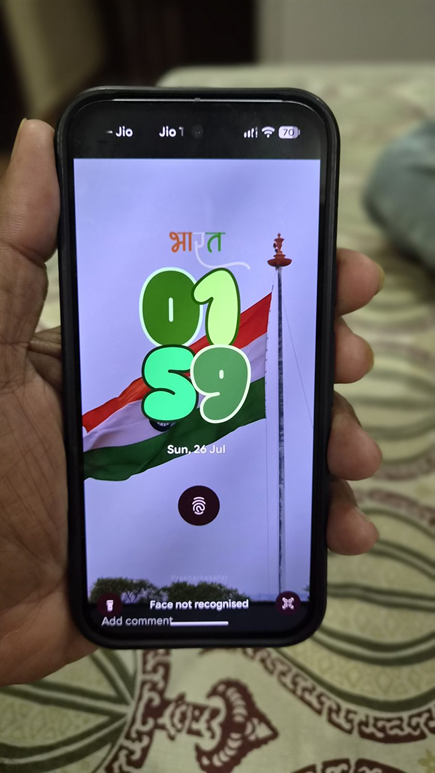
Landscape view showing the OLED panel’s colour rendition and viewing angles.

The signature Pixel camera bar on the back of the Pixel 10, shown in a protective case.

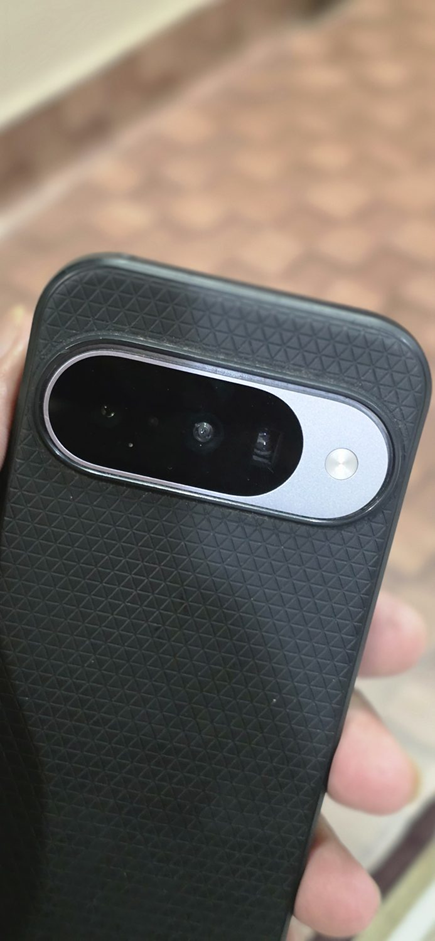
Close-up of the camera bar housing the main, ultrawide and telephoto lenses plus the flash.

Another angle on the rear camera module. The bar sits nearly flush when the phone is cased.

Display

The 6.3-inch OLED display is 1080p, compared to the Pro’s 1440p. In daily use, this difference is nearly impossible to notice. Text is crisp, videos look great, and colors are vibrant. The 120Hz refresh rate matches the Pro model. Peak brightness is lower at around 2,400 nits vs the Pro’s 3,000+ nits, which may be noticeable in very bright direct sunlight, but for most situations the display is excellent.

Performance

The Pixel 10 runs the same Tensor G5 chip as the Pro, but with 12 GB of RAM instead of 16 GB. For the vast majority of users, this makes no practical difference. Apps open at the same speed, Gemini AI features work identically, and multitasking is smooth.

The 4 GB RAM difference only matters if you keep 10+ heavy apps running simultaneously. For normal use — social media, browsing, camera, email, messaging — the 12 GB is more than enough.

Camera Performance

The Pixel 10 has the same 50 MP main camera sensor as the Pro. This means the standard Pixel 10 produces photos that are virtually identical to the Pro in most situations. The AI processing, HDR, and Night Sight are the same because they run on the same Tensor G5 chip.

What the Pixel 10 Camera Has

  • 50 MP main camera with the same sensor and processing as the Pro
  • 48 MP ultrawide with macro mode
  • Night Sight with identical quality to the Pro
  • All AI camera features: Magic Eraser, Best Take, Photo Unblur, Magic Editor
  • 4K 60fps video with excellent stabilization

What the Pixel 10 Camera Does NOT Have (Pro Only)

  • No telephoto lens (no 5x optical zoom — only digital zoom up to 8x)
  • No 8K video recording
  • Front camera is 10.5 MP vs 42 MP on Pro

The biggest compromise is the lack of a telephoto lens. If you frequently zoom in on subjects — sports events, concerts, wildlife, or far-away landmarks — you will miss the 5x optical zoom. For everything else (portraits, landscapes, food, everyday photos), the Pixel 10 delivers Pro-level quality.

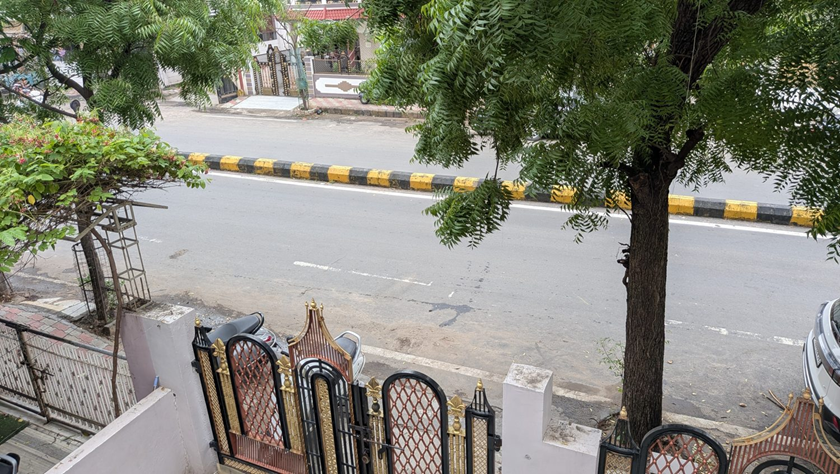
Daylight, main camera. Note how the highlights in the overcast sky are held back while the shadowed foliage keeps detail.

Same scene, slightly different framing. Greens stay natural rather than over-saturated.

Ultrawide lens. Much wider field of view with only mild softness at the far corners.

Vertical framing in daylight, straight out of the camera with no editing.

Indoors under artificial light. White balance stays neutral on a cream wall, which is a hard test.

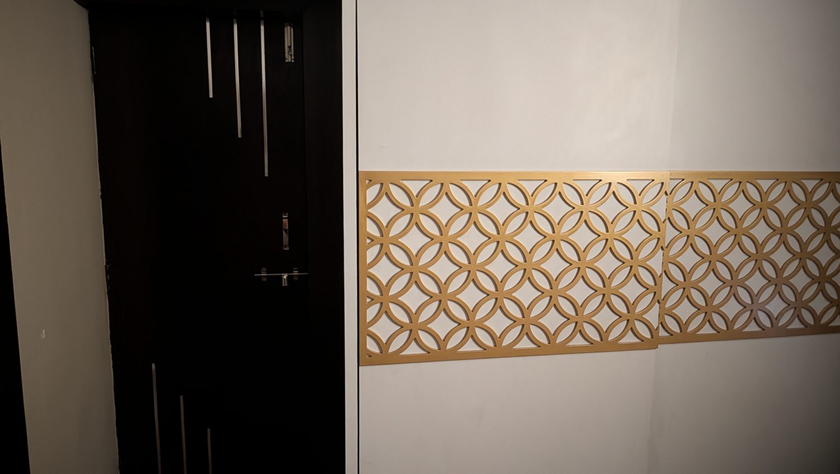
Close-up detail. Edges of the cut-out pattern stay crisp without visible sharpening halos.

Indoor portrait, full body. Skin tones look accurate and the mixed indoor lighting is handled cleanly.

Closer portrait framing. Hair detail against the patterned background is where cheaper phones usually fall apart.

Night Sight, handheld street scene. The white car and the building facade stay readable without blowing out the streetlights.

Night Sight again with more foliage in frame. Noise is controlled and the sky keeps some colour.

Very low indoor light. Night Sight pulls detail out of the wall texture that the eye barely registers.

Dim indoor corridor. Useful for showing how the phone handles deep shadow without smearing.

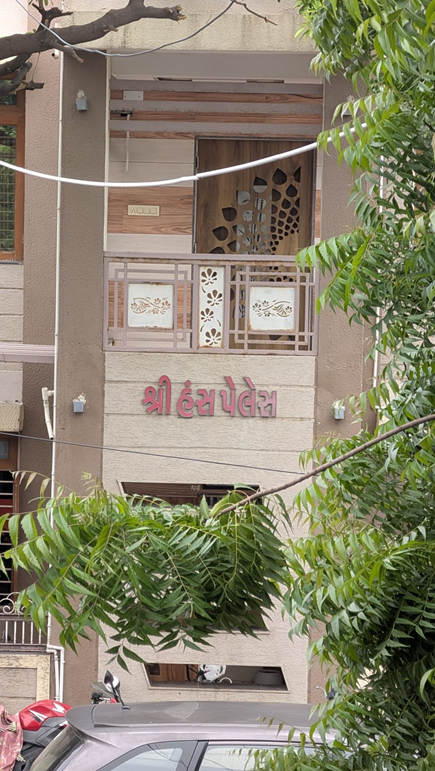
ZOOM TEST 1 of 4 – 1x. The building sign in the centre is the subject for the zoom sequence below.

ZOOM TEST 2 of 4 – 2x. Still fully optical-quality, no visible softening.

ZOOM TEST 3 of 4 – 5x. The Gujarati lettering stays legible and the edges hold up.

ZOOM TEST 4 of 4 – 10x Super Res Zoom. Detail softens but the text is still readable, which is the useful limit for most shots.

A separate cropped-in frame showing how much detail survives when you zoom into a wider street scene.

Battery Life

The 4,575 mAh battery is smaller than the Pro’s 5,050 mAh, but the 1080p display and 6.3-inch screen use less power, so battery life is comparable.

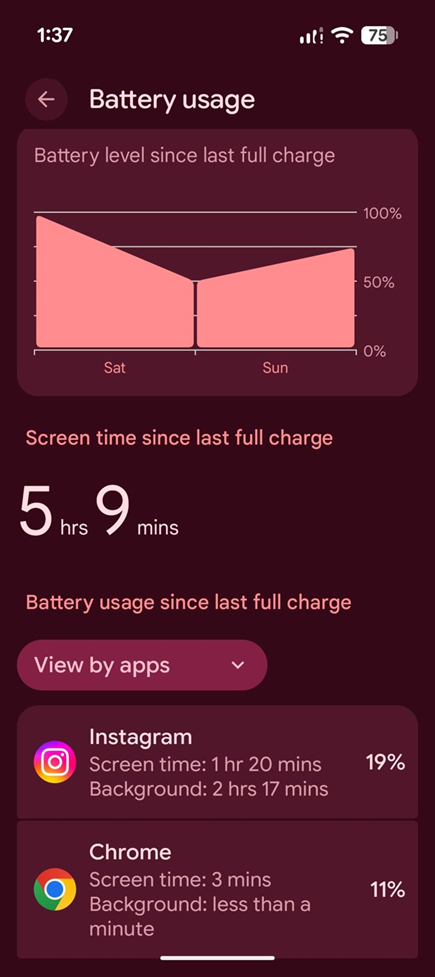
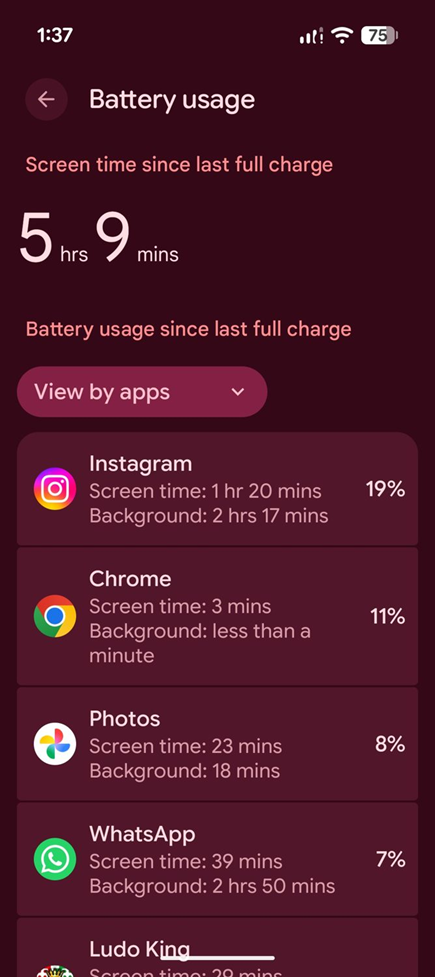
Real result: 5 hours 9 minutes of screen-on time since the last full charge, with the phone still at 75%.

Per-app breakdown. Instagram was the heaviest drain at 19% for 1 hour 20 minutes of screen time.

  • Measured result (mixed use): 5 hours 9 minutes of screen-on time with 75% battery still remaining. Usage during the test included Instagram (1 hr 20 min screen time, 2 hrs 17 min background), Chrome, Google Photos, WhatsApp and casual gaming.
  • What that means in practice: at the point the reading was taken the phone had used only 25% of its charge for over 5 hours of screen time. On that pace the Pixel 10 comfortably clears a full day of mixed use and, with lighter use, will stretch into a second morning.
  • Biggest battery drains in the test: Instagram 19%, Chrome 11%, Google Photos 8%, WhatsApp 7%. Social media with heavy background activity is the single largest drain, which matches what we see on most Tensor-powered Pixels.

Charging is slightly slower than the Pro at 27W wired. A full charge takes about 90 minutes. Wireless charging is 15W (slower than Pro’s 23W).

Software and AI Features

The Pixel 10 gets every software and AI feature that the Pro gets. There are no software differences between the two models. You get:

  • Gemini AI Assistant
  • Circle to Search
  • Call Screening
  • Live Translate (49 languages)
  • Magic Eraser, Best Take, Photo Unblur
  • 7 years of OS and security updates

This is one of the strongest reasons to choose the Pixel 10 over similarly priced Samsung phones. Samsung often limits some AI features to their Ultra models.

Pixel 10 vs Pixel 10 Pro: Is the Pro Worth $300 More?

FeaturePixel 10 ($699)Pixel 10 Pro ($999)
Display6.3 inches, 1080p6.7 inches, 1440p
RAM12 GB16 GB
Storage Options128 GB / 256 GB256 GB / 512 GB / 1 TB
Main Camera50 MP (same sensor)50 MP (same sensor)
TelephotoNo48 MP 5x optical zoom
Front Camera10.5 MP42 MP
Battery4,575 mAh5,050 mAh
Charging27W wired, 15W wireless30W wired, 23W wireless (Qi2)
Back MaterialPolycarbonateGlass
AI FeaturesAll featuresAll features (same)

The Pro is worth the extra $300 if you: need the telephoto zoom lens, want the larger screen, need 512 GB or 1 TB storage, or want faster wireless charging. The standard Pixel 10 is the better value if you: prefer a compact phone, primarily shoot wide-angle photos, do not need extreme zoom, and want to save $300.

Who Should Buy the Pixel 10

  • Anyone who wants a flagship camera without paying $999+
  • People who prefer a compact phone (6.3 inches vs 6.7 inches)
  • Users who want clean Android with all Google AI features
  • People switching from iPhone who want the simplest Android experience
  • Budget-conscious buyers who want 90% of the Pro experience for 70% of the price

Who Should Skip the Pixel 10

  • Photographers who rely on telephoto zoom (get the Pro or S26 Ultra)
  • Users who need 512 GB or 1 TB of storage
  • People who want the largest possible screen
  • Power users who want the most RAM and fastest charging

Final Verdict

The Google Pixel 10 is the best value flagship phone in 2026. At $699, you get the same Tensor G5 chip, the same 50 MP main camera, the same AI features, and the same 7 years of updates as the $999 Pro. The only meaningful compromises are the lack of a telephoto lens and a slightly smaller battery. For most people, those sacrifices are completely acceptable.

Frequently Asked Questions

What is the difference between Pixel 10 and Pixel 10 Pro?

The Pixel 10 Pro has a larger 6.7-inch display (vs 6.3), 16 GB RAM (vs 12), a telephoto zoom lens (the standard model has no zoom lens), a 42 MP front camera (vs 10.5 MP), a larger 5,050 mAh battery (vs 4,575), and a glass back (vs polycarbonate). The main camera, processor, AI features, and software updates are the same on both.

Is Pixel 10 a good phone?

Yes. The Pixel 10 offers flagship-level camera quality, the Tensor G5 processor, all of Google’s AI features, a clean Android experience, and 7 years of updates — all for $699. It is one of the best phones in its price range and offers features that competing phones at $999+ provide.

Does Pixel 10 have a good camera?

Yes. The Pixel 10 uses the exact same 50 MP main camera sensor as the Pixel 10 Pro. Google’s computational photography and AI processing produce excellent photos in all conditions. The only camera difference vs the Pro is the lack of a telephoto zoom lens — but for wide-angle and ultrawide shots, the quality is identical.